
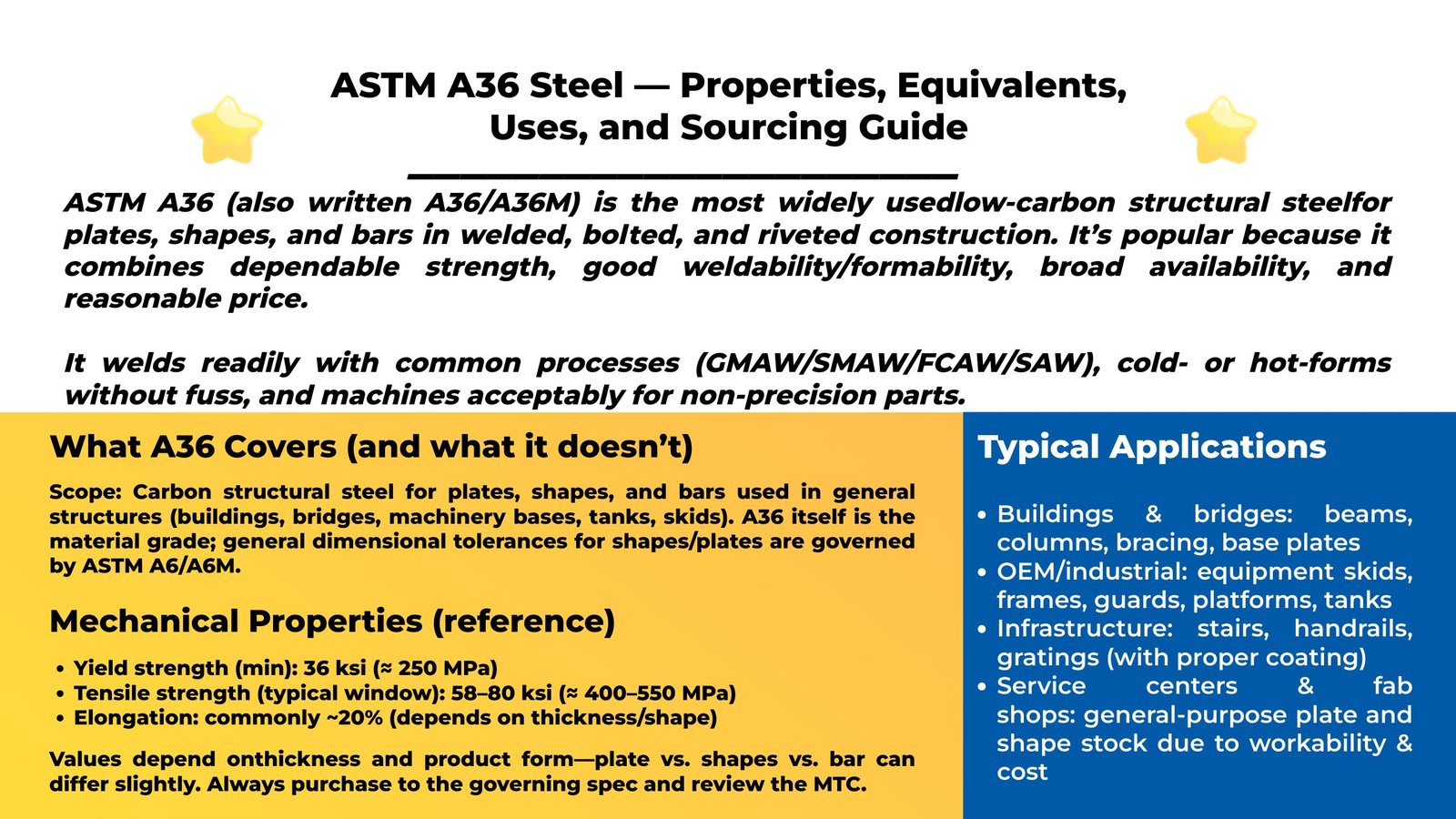
ASTM A36 (also written A36/A36M) is the most widely used low-carbon structural steel for plates, shapes, and bars in welded, bolted, and riveted construction. It’s popular because it combines dependable strength, good weldability/formability, broad availability, and reasonable price.
What A36 Covers (and what it doesn’t)
- Scope: Carbon structural steel for plates, shapes, and bars used in general structures (buildings, bridges, machinery bases, tanks, skids). A36 itself is the material grade; general dimensional tolerances for shapes/plates are governed by ASTM A6/A6M.
- Why it’s ubiquitous: It welds readily with common processes (GMAW/SMAW/FCAW/SAW), cold- or hot-forms without fuss, and machines acceptably for non-precision parts.
Chemical Composition (typical limits)
| Element | Max / Range* |
|---|---|
| Carbon (C) | ≤ ~0.25–0.29% |
| Manganese (Mn) | ~0.80–1.20% |
| Phosphorus (P) | ≤ 0.04% |
| Sulfur (S) | ≤ 0.05% |
| Silicon (Si) | ≤ 0.40% |
| Copper (Cu) | ~0.20% (when specified) |
- Exact limits vary with product form and thickness—always confirm on the Mill Test Certificate (MTC). Sources summarizing the typical ranges: Industrial Metal Supply, Octal Steel, Metals USA.
What the chemistry means in practice: Low carbon + modest Mn ⇒ good weldability and ductility, but limited through-hardening by heat treatment; if you need higher strength without adding thickness, you usually step up to HSLA grades (e.g., A572).
Mechanical Properties (reference)
- Yield strength (min): 36 ksi (≈ 250 MPa)
- Tensile strength (typical window): 58–80 ksi (≈ 400–550 MPa)
- Elongation: commonly ~20% (depends on thickness/shape)
Values depend on thickness and product form—plate vs. shapes vs. bar can differ slightly. Always purchase to the governing spec and review the MTC.
Machinability & fabrication
- Machinability index ~72% (vs. 100% for AISI 1112 reference) with typical cutting speeds ~120 ft/min—adequate for general work, but not as easy as 1018.
- Weldability: readily weldable with common processes; preheat usually minimal for thin to medium sections, guided by joint design and carbon equivalent.
Dimensional Tolerances
ASTM A36 gives the grade; ASTM A6/A6M gives the mill tolerances for structural shapes and plates (straightness, camber, twist, thickness, width/length). Designers and buyers typically also apply AISC Manual tables derived from A6 when checking fit-up risk.
Product Forms & Common Supply Conditions
- Plates (HR, often P&O), wide-flange beams, channels, angles, bars (flats, rounds, squares), and flame- or laser-cut blanks. Surface is mill scale in as-rolled condition; pickling, blasting/priming available.
A36 vs. Nearby Structural Grades
A36 vs. A572 Grade 50 (HSLA)
- A572 Gr50 has higher yield strength (50 ksi) and better strength-to-weight; A36 is easier to form and usually cheaper. They serve similar markets (plate, shapes) but are not interchangeable without re-checking design.
For general structural purposes, engineers often cross-reference A36 with “~235–250 MPa yield” steels:
| System | Grade (typical) | Comment |
|---|---|---|
| EN 10025-2 | S235JR | Very close strength window to A36; JR adds a Charpy impact level (27 J @ +20 °C) that A36 itself doesn’t mandate. |
| JIS G3101 | SS400 | Common Asian mild steel; strength ranges overlap A36. |
| GB/T 700 | Q235B | PRC structural steel near 235 MPa yield. (Use local code rules.) |
Substitution caution: “Equivalent” ≠ “identical.” Check impact class (JR/J0/J2), thickness windows, and project code rules before swapping.
Typical Applications
- Buildings & bridges: beams, columns, bracing, base plates
- OEM/industrial: equipment skids, frames, guards, platforms, tanks
- Infrastructure: stairs, handrails, gratings (with proper coating)
- Service centers & fab shops: general‐purpose plate and shape stock due to workability & cost
Sizing & Purchasing Checklist
- Grade & spec: ASTM A36/A36M
- Product form & size: plate/shape/bar, thickness, width, length (or section size)
- Tolerances: per ASTM A6/A6M (note any special straightness/flatness)
- Surface condition: as-rolled, P&O, blasted/primed, or galvanized
- Weld procedure constraints (if any) and NDT requirements
- Test documents: EN 10204 3.1 MTC with chemistry + mechanicals
- Coating/painting/galvanizing notes and packaging
- Quantity, Incoterms, destination port
FAQs
Is A36 heat-treatable for higher strength?
Only to a limited extent: with its low carbon, A36 does not significantly through-harden like alloy steels. If you need strength above A36 without adding thickness, consider A572 or other HSLA grades.
What are the most common A36 plate thicknesses?
Service-center inventories vary by region, but A36 plate commonly spans thin gauges up to heavy thicknesses for structural use; check local stock lists. (Ryerson/Kloeckner overviews.)
How “close” is S235JR to A36?
Very close in yield/tensile windows for general use, but S235JR has a defined impact requirement; many EU projects therefore specify S235JR rather than A36. Always follow the project code.
What standards control shape/plate tolerances?
ASTM A6/A6M for carbon structural shapes and plates; AISC Manual reproduces key tables commonly used by designers/fabricators.
How easy is A36 to machine and weld?
Weldability is excellent with common processes; machinability ~72% with typical speeds around 120 ft/min—fine for general work, but 1018 machines cleaner if precision finish matters.
A36 vs A572: quick chooser
- Pick A36 for cost-effective, easy forming/welding in low-to-moderate stress structures.
- Pick A572 Gr50 when you need higher strength (lighter sections for the same capacity) and better strength-to-weight. Re-check design if substituting.
Vietnam North Metal Provides High Quality ASTM A36 Steel
Please let us know your procurement requirements, and we will quickly tailor the most competitive quotation for you.
- info@vnnorthmetal.com
- +44 7763387000
- Jenny-Vietnam North Metal