
Cold rolling is a highly refined metalworking process that plays a critical role in the manufacturing of products that require superior surface quality, tight dimensional tolerances, and improved mechanical properties. It is an essential technique used in a variety of industries, including automotive, construction, aerospace, electrical, and consumer goods. Unlike hot rolling, cold rolling is carried out at or near room temperature, leading to enhanced strength, better surface finish, and higher dimensional accuracy.
This article explores the cold rolling process in detail, discussing how it works, the equipment involved, its advantages and disadvantages, its many industrial applications, and how new technologies are shaping its future.
What is Cold Rolling?
Cold rolling is a metal forming process in which metal is passed through a series of rollers at room temperature (below the metal’s recrystallization point) to reduce its thickness, improve surface finish, and enhance mechanical properties. Since the process is performed without heating, it requires more force than hot rolling, but produces higher quality finished products.
Cold rolled metals exhibit increased yield strength and hardness due to strain hardening and typically require annealing to relieve internal stresses and improve ductility.
Materials Used in Cold Rolling
Cold rolling is suitable for a variety of ferrous and non-ferrous metals, such as:
- Steel (carbon steel, alloy steel, stainless steel)
- Aluminum
- Copper
- Brass
- Titanium
- Nickel and nickel alloys
Among these, cold rolled steel is the most commonly produced and widely used in numerous applications requiring high precision.
Cold Rolling Process: Step-by-Step
1. Pickling (Optional)
Before cold rolling, the metal surface may be pickled using an acid solution to remove oxides and scales left from previous hot rolling or casting.
2. Rolling
The metal strip is passed through pairs of rollers (called stands) with decreasing gaps to progressively reduce the thickness. This is typically done in multiple passes to achieve the desired dimensions.
3. Annealing (Optional)
The cold rolling process induces strain hardening. Annealing is used to soften the material, relieve internal stresses, and enhance ductility for further processing.
4. Skin Pass (Temper Rolling)
This light cold rolling pass imparts a final surface texture, eliminates yield point elongation, and improves flatness.
5. Surface Finishing
Processes like polishing, brushing, and coating may be used to achieve specific aesthetic or functional surface finishes.
Equipment Used in Cold Rolling
1. Rolling Mill Stands


Consist of working rolls, backup rolls, and support structures to apply pressure and reduce thickness.
2. Coil Payoff and Recoilers

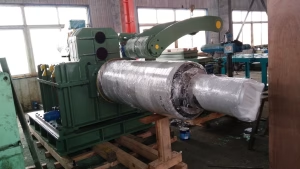
Used to feed metal strip into the mill and collect it after processing.
3. Tension Bridle


Applies tension to the strip to maintain consistency during rolling.
4. Lubrication and Cooling System
Ensures the working rolls and strip remain cool and properly lubricated to prevent wear and defects.
5. Automatic Gauge Control (AGC)
Advanced sensors and feedback systems control roll pressure and gap to maintain precise thickness.
Types of Cold Rolling Mills
1. Two-High Mill
Simplest design with two opposing rollers. Suitable for small batches and basic thickness reductions.
2. Four-High Mill
Two smaller working rolls backed by larger backup rolls. Offers better roll deflection control and is commonly used in industrial production.
3. Cluster and Sendzimir Mills
Use multiple backup rolls to support small working rolls, ideal for rolling very thin materials with high strength.
4. Tandem Mills
Consist of several stands in series allowing continuous processing for high-volume production.
Advantages of Cold Rolling
1. Superior Surface Finish
Cold rolling produces a smoother, shinier surface free of scale and oxidation.
2. Higher Strength and Hardness
Strain hardening increases tensile strength, yield strength, and hardness.
3. Improved Dimensional Accuracy
Cold rolled products feature tight tolerances and consistent thickness.
4. Enhanced Flatness
The process improves flatness and eliminates warping or waviness in the material.
5. Better Formability for Secondary Processes
Cold rolled products are well-suited for stamping, drawing, punching, and other fabrication methods.
Disadvantages of Cold Rolling
1. Higher Energy and Equipment Costs
Requires more powerful equipment and energy due to greater deformation resistance.
2. Lower Ductility Without Annealing
Cold rolled metals are less ductile and may require annealing before further processing.
3. Limited Thickness Reduction Per Pass
Smaller thickness reductions per pass require multiple passes for significant deformation.
4. Internal Stresses
Residual stresses can lead to distortion unless relieved by annealing.
Applications of Cold Rolled Products
Automotive
- Body panels
- Structural reinforcements
- Engine components
Construction
- Steel framing
- Roofing and cladding
- Doors and window frames
Appliances
- Refrigerator panels
- Washing machine drums
- Microwaves and ovens
Electrical and Electronics
- Transformers
- Motor laminations
- Battery enclosures
Consumer Goods
- Furniture
- Shelving units
- Lighting fixtures
Packaging
- Steel cans and containers
- Foils and wraps
Cold Rolling vs. Hot Rolling
| Feature | Cold Rolling | Hot Rolling |
|---|---|---|
| Temperature | Room temperature | Above recrystallization temperature |
| Surface Finish | Smooth, bright | Rough, oxidized |
| Strength | Higher (due to strain hardening) | Lower (unless treated after) |
| Dimensional Accuracy | Very precise | Less precise |
| Internal Stresses | Present (annealing needed) | Generally absent |
| Production Volume | Lower throughput | High throughput |
| Cost | Higher | Lower |
Surface Finishing Options
- Matte or bright finishes
- Oil coating for corrosion resistance
- Galvanizing for zinc coating
- Electroplating for chrome or nickel
- Embossing and texturing for aesthetic or functional purposes
Quality Control in Cold Rolling
Ensuring consistent quality involves:
- Real-time thickness monitoring
- Surface defect inspection (scratches, pits, waviness)
- Flatness and edge profile control
- Mechanical testing (tensile, hardness)
- Microstructural analysis
Many cold rolling lines are now equipped with AI-powered systems to detect and correct defects automatically.
Environmental Considerations
Although cold rolling is generally more energy-efficient than hot rolling per unit of product thickness reduction, it still poses several environmental challenges:
- High electricity consumption
- Lubricant disposal and recycling
- Emissions from pickling and annealing
- Waste management from offcuts and damaged coils
Modern mills use closed-loop lubrication systems and cleaner annealing processes to minimize environmental impact.
Innovations and Future Trends
1. Digital Twin and Smart Manufacturing
Simulated models of rolling processes help optimize operations and reduce waste in real time.
2. Advanced High-Strength Steels (AHSS)
Cold rolling is increasingly used to process AHSS for automotive lightweighting and safety.
3. Automation and AI Integration
Intelligent systems are revolutionizing quality control, predictive maintenance, and production optimization.
4. Hybrid Lines
Combining cold rolling with galvanizing, annealing, and coating in one line for more efficient, high-speed processing.
5. Green Rolling Practices
Increased use of renewable energy, energy-efficient motors, and sustainable lubrication technologies.
Conclusion
Cold rolling is an indispensable process in modern manufacturing, delivering high-quality metal products with exceptional surface finishes, precise tolerances, and enhanced mechanical properties. From automotive panels to electronics enclosures, the versatility of cold rolled metals makes them vital to countless applications.
As industries pursue higher efficiency, lighter materials, and sustainable production, cold rolling continues to evolve with innovations in digital control, materials science, and environmental management. Understanding the process, its strengths, limitations, and future trends is essential for manufacturers, engineers, and decision-makers looking to remain competitive in an ever-advancing industrial landscape.